HISTORICAL COMPANION
A Guide to
A Younger Ireland
Daniel O’Connell, Young Ireland and Ireland in the 1840s
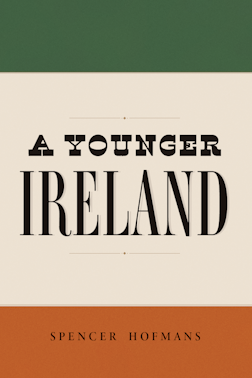
The Novel
History is easy to inherit. Harder to know what to do with it.
A Younger Ireland begins in Larne in 1840, where seventeen-year-old Daniel Darragh returns from school in disgrace on the same morning his grandfather Alec dies. In the butcher’s shop of his father Bernard and grandmother Florence, Daniel inherits more than a trade. He inherits Alec’s manuscript, the memory of 1798, and questions his family has never quite settled.
Restless, curious and determined to see things for himself, Daniel is drawn from Larne into Belfast and Dublin. Through Charles Gavan Duffy and The Nation, he encounters the generation that will become Young Ireland, while Daniel O’Connell’s campaign for Repeal still commands the country’s political imagination. Daniel begins writing as A Northerner, learning that reporting means looking past the argument to the people living underneath it.
Then hunger changes the questions.
As famine, political division and the upheavals of 1848 test the certainties of a younger generation, Daniel must decide what can be inherited from the past, and what must be learned anew.
At its heart, Spencer Hofmans’ A Younger Ireland is a story about history passing from one generation to the next, and what happens when inherited ideals meet the lives of real people.
Ireland after the Union
Ireland entered the nineteenth century without a parliament of its own.
The Acts of Union came into force on 1 January 1801, joining Great Britain and Ireland in a single United Kingdom governed from Westminster. Irish representatives remained in parliament, but the legislature in Dublin was gone. For those who opposed the Union, the question became not whether Ireland should be governed, but where political authority over Ireland ought to reside.
Daniel O’Connell transformed that question into mass politics. His campaign for Catholic emancipation helped force a major constitutional change in 1829, allowing Catholics to sit in parliament. But emancipation did not end O’Connell’s ambitions. He increasingly turned towards Repeal of the Union, seeking the restoration of an Irish parliament while maintaining the connection with the Crown.
By 1840, when A Younger Ireland begins, Ireland had already learned that political change was possible.
The argument was over how much change should come next.
Daniel O’Connell and Repeal
O’Connell founded the Repeal Association in 1840 and built it into another mass political movement.
Its strength lay not in secrecy but in visibility: subscriptions, meetings, newspapers, speeches and enormous public gatherings. In 1843, proclaimed by O’Connell as the “year of Repeal”, so-called monster meetings were held at places chosen partly for their historical resonance. Politics became landscape. Tara, Mullaghmast and other sites were made to carry the weight of older Ireland into the present.
The campaign reached its crisis at Clontarf in October 1843. The government prohibited the planned meeting at the last moment and deployed troops. Rather than risk a violent confrontation, O’Connell cancelled it. He and several associates were subsequently prosecuted and imprisoned, although the House of Lords overturned their convictions in 1844.
To admirers, Clontarf demonstrated O’Connell’s refusal to purchase political progress with blood.
To some younger nationalists, it raised a more difficult question.
What happened when moral force met a government that simply said no?
The Nation and Young Ireland
A new voice had already entered the argument.
On 15 October 1842, Charles Gavan Duffy, Thomas Davis and John Blake Dillon published the first issue of The Nation. They supported Repeal, but their ambitions extended beyond a single constitutional demand. Through politics, history, poetry, music and literature, the paper sought to cultivate the idea that Ireland was not merely a territory seeking better government but a nation capable of imagining itself.
Around the paper gathered the writers and activists later known as Young Ireland.
They were never entirely of one mind. Davis stressed a nationality that might cross religious divisions. Duffy built the newspaper and its network of contributors. Dillon brought a strong interest in land and political organisation. John Mitchel, who became increasingly important after Davis’s death in 1845, moved towards a far more confrontational politics.
That disagreement mattered.
A generation can share a destination long before it agrees upon the road.
Hunger and the Great Famine
Then the argument changed because the country changed.
Potato blight appeared in Ireland in 1845 and returned in succeeding years. For millions who depended heavily upon the potato, crop failure became hunger, disease, eviction and migration. By the time of the 1851 census, Ireland’s population had fallen dramatically through both death and emigration. Modern scholarship commonly places the wider famine period between 1845 and 1852.
Relief took many forms: public works, soup kitchens, workhouses, local relief committees and government commissions. The surviving Distress Papers preserve thousands of reports, letters and petitions from communities seeking assistance. From 1847, Poor Law changes placed greater responsibility on local systems of relief, while the so-called quarter-acre or Gregory clause meant that people occupying more than a quarter acre generally could not qualify for relief without surrendering land above that limit.
Political ideas now had to compete with immediate things.
Food. Rent. Land. Work. A place to sleep.
For Young Ireland, the national question could no longer remain only constitutional.
The Break with O’Connell
The division had been growing before famine made it sharper.
O’Connell regarded the renunciation of political violence as both a principle and a practical necessity. Some of the younger nationalists agreed that armed revolt under existing conditions would be disastrous, but refused to declare that force could never be justified under any circumstances.
The dispute came to a head in the Repeal Association in July 1846. Thomas Francis Meagher defended that distinction in the speech that later earned him the name “Meagher of the Sword”. O’Connell’s supporters insisted upon an unqualified commitment to moral force. The Young Irelanders withdrew from the Association.
In January 1847 they established the Irish Confederation.
But leaving O’Connell did not resolve their own disagreements. James Fintan Lalor increasingly argued that national independence could not be separated from the ownership and use of land. Mitchel moved towards revolutionary confrontation. Duffy remained more cautious. By the end of 1847, Mitchel had left The Nation to establish the United Irishman.
Young Ireland had broken away.
Now it began to break within itself.
1848 and the Young Ireland Rising
In February 1848, revolution in Paris overthrew the French monarchy.
The news travelled quickly. Across Europe, governments fell or faced uprisings, and for Irish nationalists the impossible suddenly appeared less impossible. Meagher and other Irish delegates travelled to Paris; he returned with the green, white and orange tricolour that would later become Ireland’s national flag.
But Ireland was not France.
John Mitchel was convicted and transported in May. Duffy was arrested in July. The government moved against nationalist organisations and suspended habeas corpus as fears of insurrection grew. With leaders facing arrest and their organisation under pressure, William Smith O’Brien and several colleagues attempted to raise a rebellion in the south-east.
The decisive encounter came near Ballingarry, County Tipperary, on 29 July 1848, where O’Brien’s followers confronted police barricaded inside the McCormack farmhouse. The engagement was brief. The rebellion dispersed, and many of its leaders were arrested soon afterwards.
Europe had caught fire.
In Ireland, the flame barely took.
What Happened Afterwards?
The rising failed, but Young Ireland did not simply disappear.
Several of its leaders, including William Smith O’Brien and Thomas Francis Meagher, were convicted of high treason. Their death sentences were commuted and they were transported to Van Diemen’s Land, present-day Tasmania. Others escaped abroad. Duffy, imprisoned before the rising and repeatedly tried afterwards, eventually secured his release and revived The Nation in 1849.
The generation scattered.
Some carried its politics into exile. Others turned towards land reform, parliamentary politics or later revolutionary movements. Duffy eventually emigrated to Australia, where he entered politics and later became premier of Victoria. Meagher escaped to the United States and followed a very different path.
What survived most easily was not organisation.
It was print.
Newspapers, poems, memoirs, speeches and arguments remained after the meetings had emptied and the leaders had gone. Young Ireland had failed to make the revolution some of its members imagined.
But it had helped teach another generation how to imagine Ireland.
Historical Figures
These are the historical figures who step into the story of A Younger Ireland.
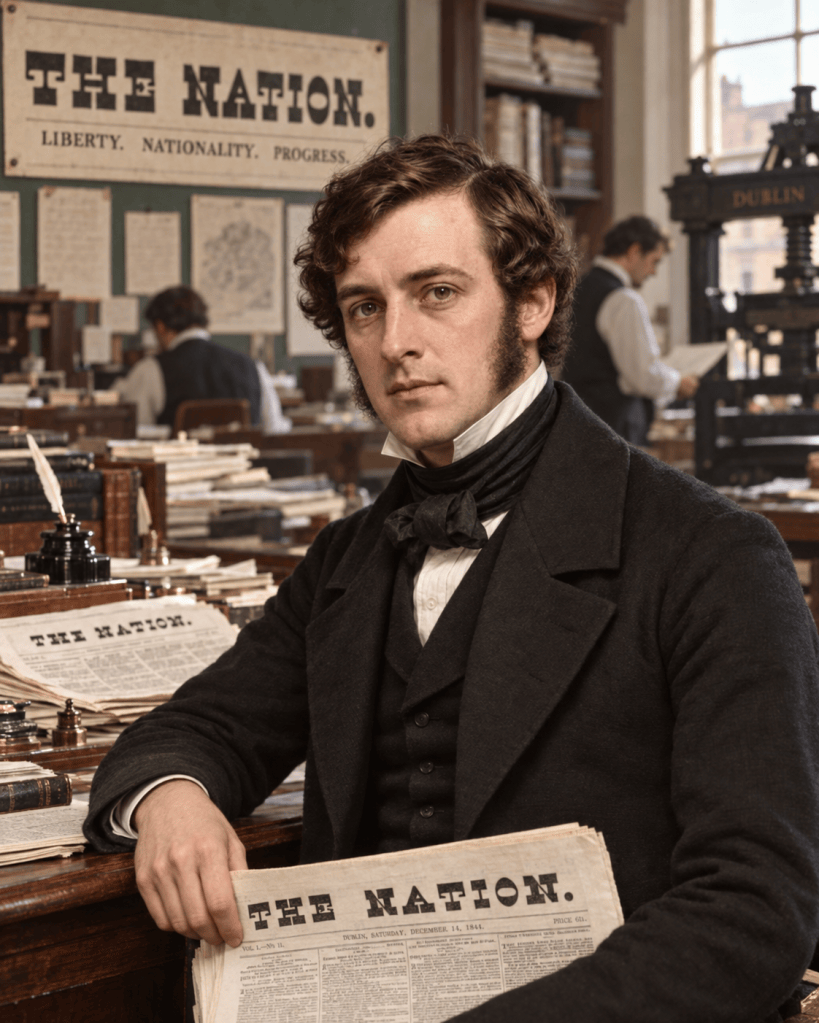
Charles Gavan Duffy (1816–1903)
A journalist from Monaghan, Duffy co-founded The Nation with Thomas Davis and John Blake Dillon in 1842 and served as its editor, making the newspaper one of the principal voices of Young Ireland. After repeated prosecutions and the collapse of the movement in 1848, he eventually emigrated to Australia, where he entered politics and served briefly as premier of Victoria.
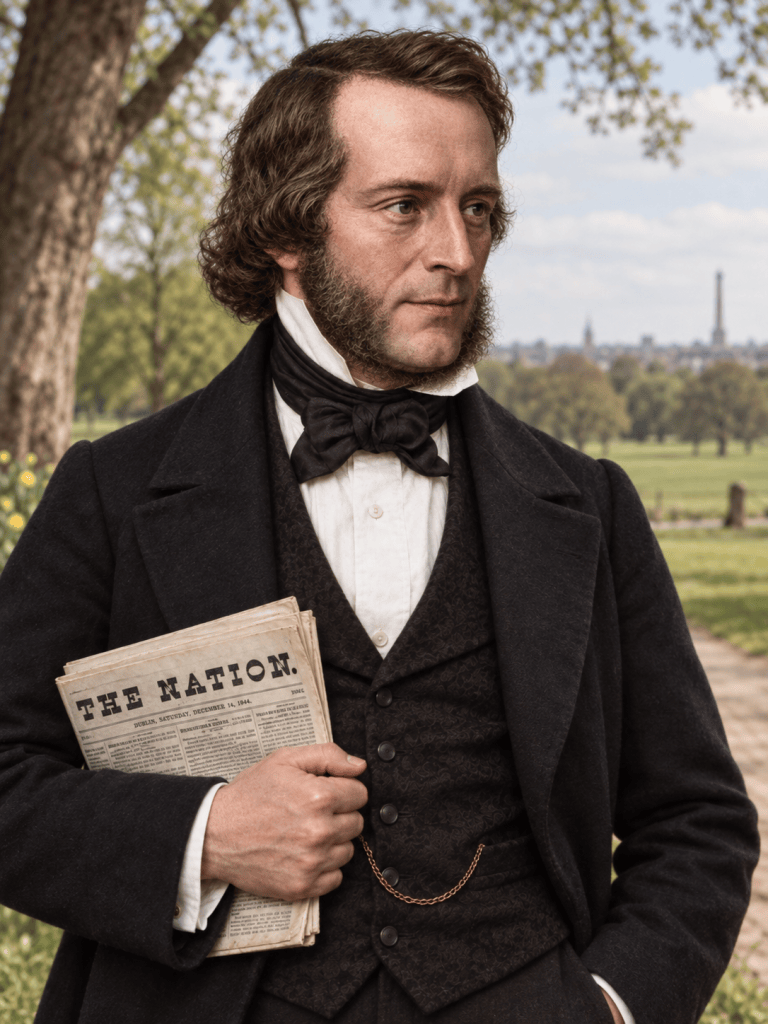
Thomas Davis (1814–1845)
A Protestant writer, poet and political thinker, Davis co-founded The Nation and became the leading intellectual influence on the early Young Ireland movement. He promoted an inclusive Irish nationality that sought to transcend religious and ethnic divisions, and his sudden death in 1845 deprived the movement of one of its principal unifying figures.
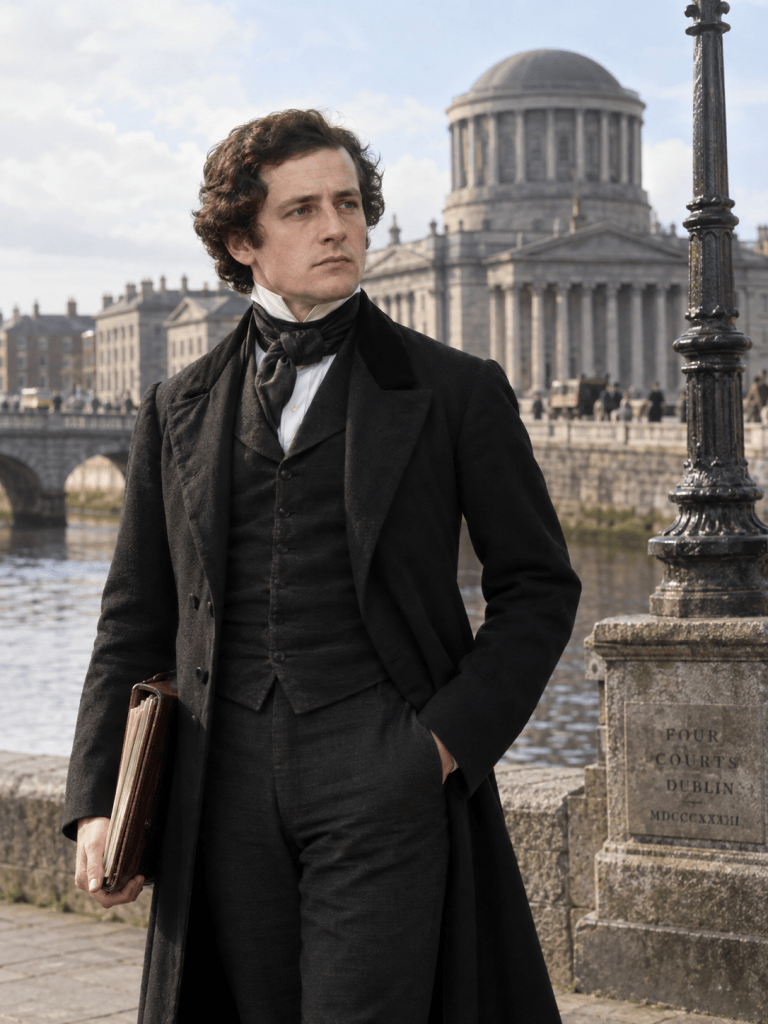
John Blake Dillon (1814–1866)
A barrister and close friend of Thomas Davis, Dillon joined the Repeal Association and became, with Davis and Duffy, one of the three founders of The Nation in 1842. He later joined the Irish Confederation and participated in the events of 1848, after which he fled Ireland before eventually returning under an amnesty.
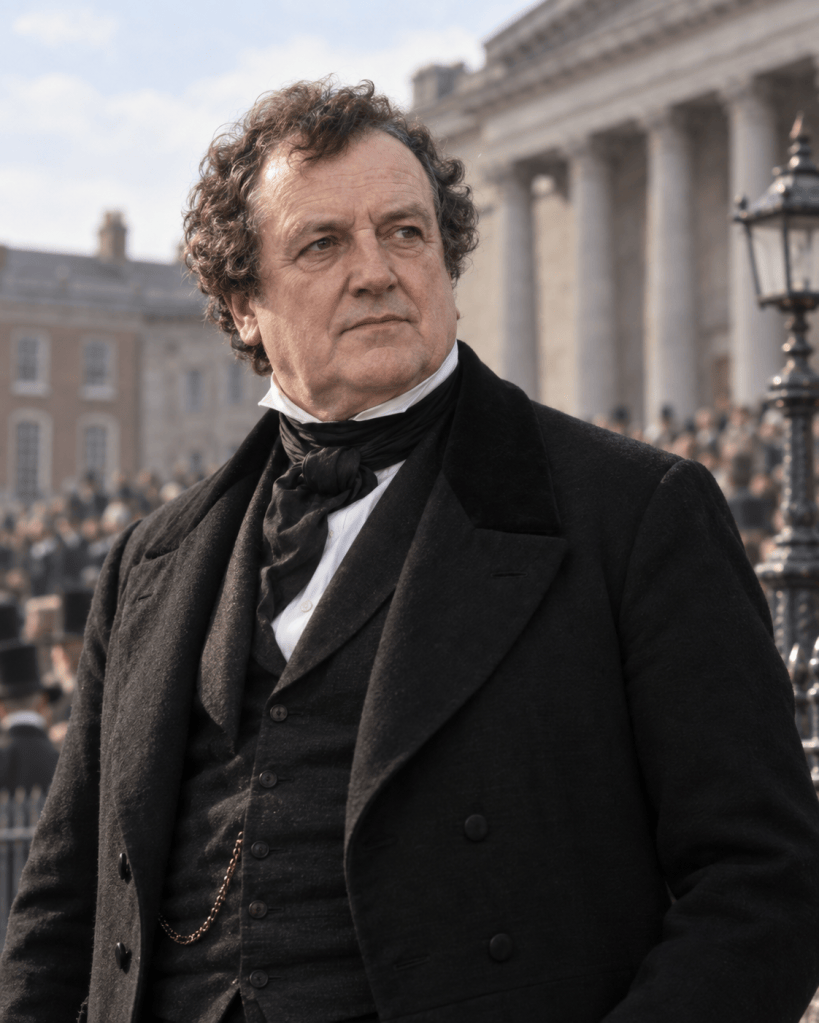
Daniel O’Connell (1775–1847)
A barrister and mass political organiser, O’Connell led the campaign that culminated in Catholic emancipation in 1829 and later sought the repeal of the Act of Union through constitutional and non-violent political action. His Repeal movement dominated Irish politics in the early 1840s, but disagreements over political violence and strategy eventually produced a rupture with the younger nationalists who became known as Young Ireland.

Thomas MacNevin (1814–1848)
A barrister, historian and journalist, MacNevin was a close friend of Thomas Davis and became a prolific contributor to The Nation and a prominent Young Ireland voice within the Repeal Association. He was particularly interested in making Irish history accessible to a wider readership, producing works on the political trials and public figures of earlier generations before withdrawing from public life because of severe mental illness.
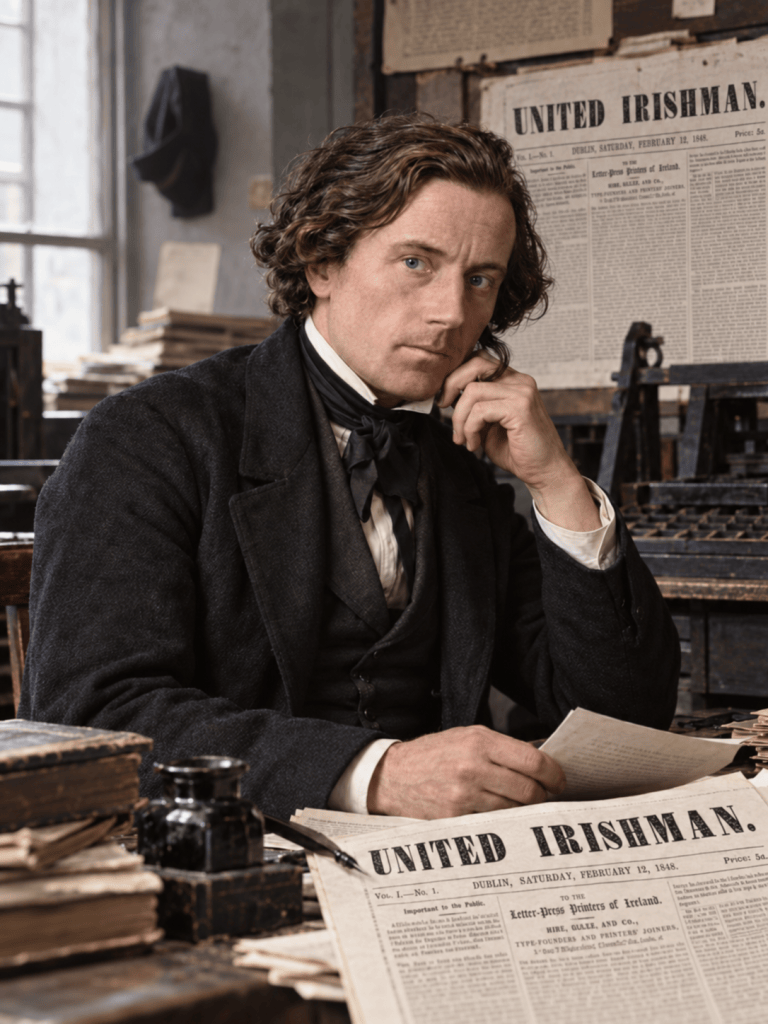
John Mitchel (1815–1875)
A journalist from Ulster, Mitchel joined The Nation in 1845 and increasingly argued for a more confrontational response to British rule and to the catastrophe of the Great Famine. He broke with Duffy, founded the United Irishman in 1848 and was transported for treason felony; in later life in the United States he became an outspoken defender of slavery and supporter of the Confederacy.
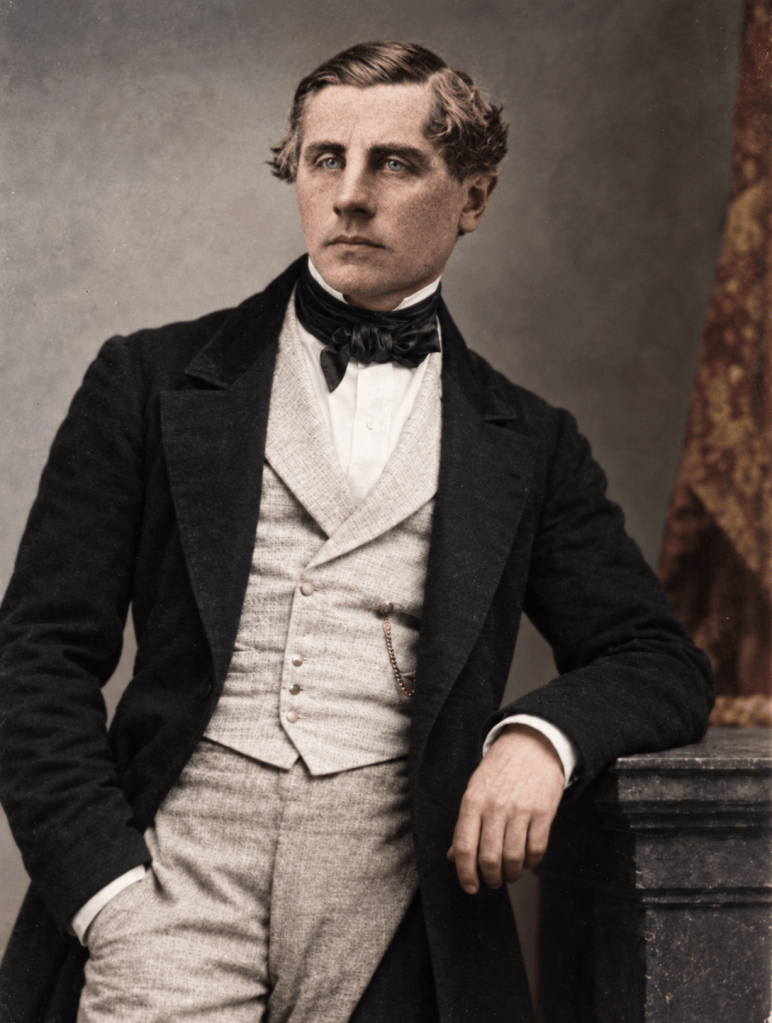
Thomas Francis Meagher (1823–1867)
A gifted orator from Waterford, Meagher became one of the most visible younger members of the Repeal movement and defended the possible use of force in his celebrated 1846 “Sword Speech”. He joined the Irish Confederation, participated in the events of 1848 and helped introduce the green, white and orange tricolour before later becoming a Union general in the American Civil War.
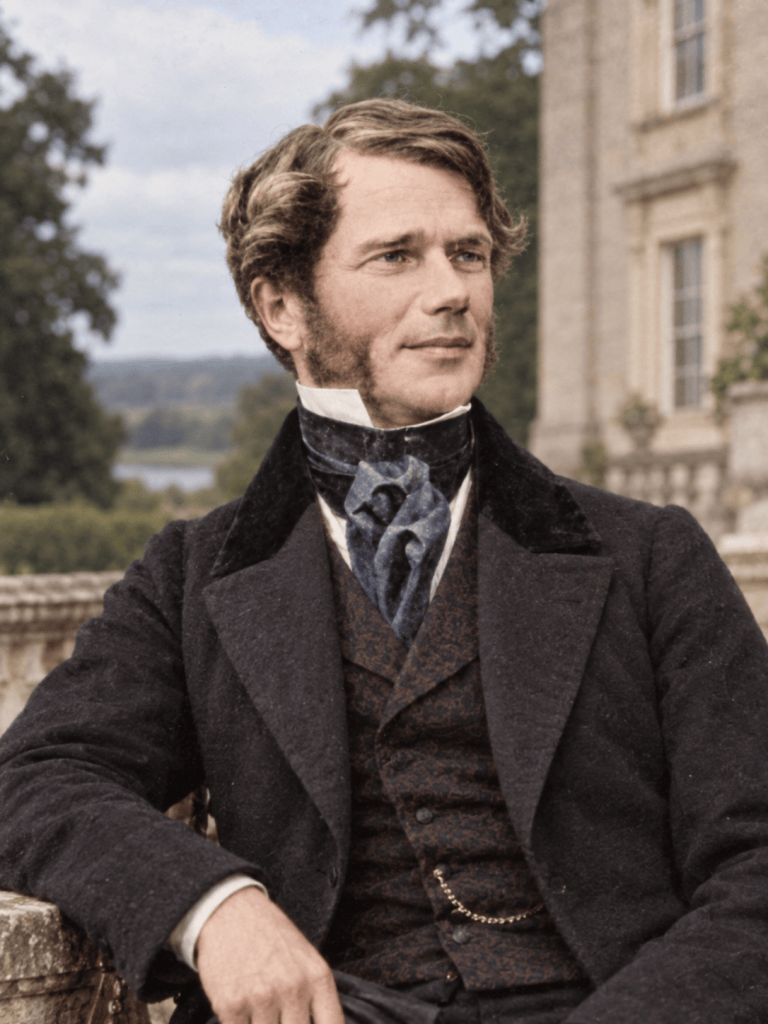
William Smith O’Brien (1803–1864)
A Protestant landowner and long-serving MP, O’Brien joined O’Connell’s Repeal Association in 1843 and subsequently emerged as a leading figure among the Young Irelanders and the Irish Confederation. In 1848 he became the principal leader of the attempted rising in Tipperary, was convicted of high treason and had his death sentence commuted to transportation to Van Diemen’s Land.
Every generation receives the past unfinished.
Sources and Further Reading
The world of A Younger Ireland was built from contemporary newspapers, political writing, personal recollections and records of the Great Famine, alongside later scholarship on Repeal and the Young Ireland movement. The following are among the sources that informed the novel and this guide.
Primary and Contemporary Sources
- The Nation
Founded in Dublin in 1842 by Charles Gavan Duffy, Thomas Davis and John Blake Dillon, The Nation brought politics, history, literature and poetry together in the service of Irish nationality. Its pages provide a week-by-week record of the arguments, personalities and changing language of the movement from which Young Ireland emerged. - United Irishman
Founded by John Mitchel after his departure from The Nation in 1848, the paper captures the increasingly revolutionary politics of the months immediately preceding Mitchel’s arrest and transportation. It offers a striking contrast with Duffy’s more cautious editorial course during the same crisis. - The Distress Papers and Relief Commission Records, National Archives of Ireland
Letters, reports, petitions and official returns documenting hunger, relief efforts and local conditions during the Great Famine. They preserve the administrative language of the crisis alongside the voices of communities asking for assistance. - Charles Gavan Duffy, Young Ireland: A Fragment of Irish History and Four Years of Irish History
Duffy’s later recollections draw heavily on The Nation, his own papers and the memories of those who participated in the movement, making them indispensable firsthand accounts of Young Ireland, though also accounts written with the hindsight and judgments of a survivor. - Michael Doheny, The Felon’s Track
First published shortly after the events of 1848, Doheny’s memoir records the politics, personalities and collapse of the Young Ireland rising from the perspective of a participant who escaped arrest and fled Ireland.
Historical Studies
- Kevin B. Nowlan, The Politics of Repeal
A major study of Daniel O’Connell’s Repeal movement and the political world from which Young Ireland emerged. - Richard Davis, The Young Ireland Movement
A detailed study of the ideas, personalities and internal divisions of Young Ireland, placing the movement within the wider political culture of nineteenth-century Ireland. - Denis Gwynn, Young Ireland and 1848
An account of the development of Young Ireland and the events that culminated in the attempted rising of 1848. These works remain regularly cited in modern biographical scholarship on the movement.
Literary Context
- Thomas Davis and the writers of The Nation
Ballads, poems and historical essays were central to the Young Ireland project. Davis in particular used literature alongside political journalism to cultivate a shared sense of Irish nationality, while contributors such as John O’Hagan helped turn history and politics into material that could be read, remembered and recited. - The Spirit of the Nation
Collections of verse associated with The Nation show how closely poetry, song and politics were intertwined in the culture of Young Ireland. They offer a different kind of historical evidence: not simply what the movement argued, but how it hoped Ireland might feel about itself.
CONTACT SPENCER
For interviews, speaking engagements, literary events, or other enquiries.
contact@spencerhofmans.com
 Spencer Hofmans